
|
Getting your Trinity Audio player ready... |
Social Media Account Closures
Why Platform Bans Are Surging and How Businesses Can Safeguard Their Digital Assets

In recent months, social media marketing teams worldwide have encountered an urgent new threat: sudden, automated account closures. Leading platforms like Meta, TikTok, and X have rapidly intensified their use of fully autonomous AI moderation systems to remove non-compliant, fraudulent, or suspicious accounts at scale. Although these automated sweeps are intended to reduce spam and enforce global regulations, the lack of human oversight has led to thousands of legitimate businesses having their ad accounts, organic pages, and digital storefronts disabled, often without warning or clear justification.
For modern organizations, an unexpected platform ban disrupts customer acquisition pipelines, erodes brand trust, and instantly cuts off primary revenue channels. Understanding the technical mechanisms driving this surge in account terminations is essential for preserving your digital presence and establishing operational resilience.
The Factors Driving Social Media Account Suppression Surge
Social media account suspensions are surging due to three key factors: rapid technological shifts, aggressive platform self-regulation, and stricter global compliance laws.
1. Fully Autonomous AI Moderation Systems
To handle billions of daily interactions, platforms now rely on fully automated machine learning rather than human reviewers. According to the Meta Oversight Board, these automated systems disable billions of accounts annually, often without transparency, due process, or nuanced judgment. If an algorithm misinterprets your context or intent, your account is banned instantly, with no human review during the initial enforcement or the appeals process.
2. High Statistical Prevalence of Account Moderation
Account enforcement is no longer rare. Research published in MIS Quarterly shows that 21.5% of active social media users across studied networks experienced account bans or severe restrictions. Additionally, research from the Harvard Kennedy School Misinformation Review highlights a critical technical flaw driving this surge: automated systems cannot understand human context. When natural language processing algorithms fail to grasp user intent, often misinterpreting harmless marketing copy as a policy violation, platforms routinely default to wrongful account takedowns.
3. Aggressive Regulatory Mandates
Global legislative updates have forced platforms to implement stringent, zero-tolerance filtering mechanisms. Under regulatory frameworks such as the EU’s Digital Services Act and the UK’s Online Safety Act, jurisdictions worldwide hold tech platforms legally and financially liable for compliance failures, with fines up to 6% of global revenue. Sprout Social’s Q1 2026 Survey reveals that platforms are deploying strict age, identity, and content algorithms to avoid multimillion-dollar fines, inadvertently trapping legitimate business accounts in false positives.
Primary Technical Triggers Behind Commercial Account Bans
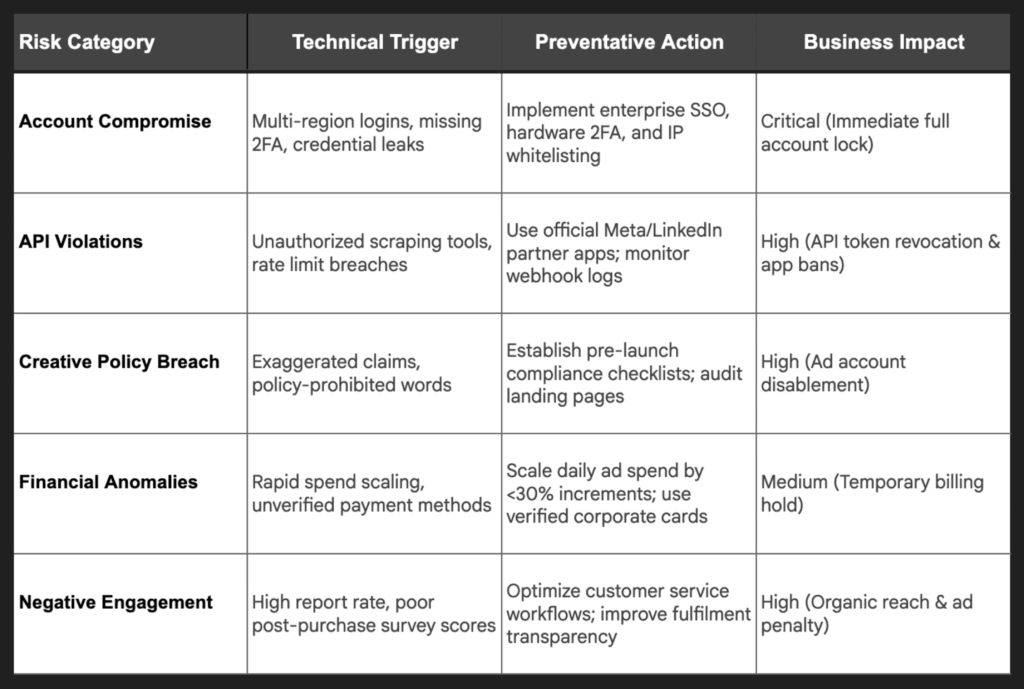
Most automated business suspensions happen when specific technical or operational anomalies trigger platform security filters. According to industry benchmarks in the BlackScale Media Compliance Report, the following factors pose the highest risk to commercial accounts:
- Unusual Activity & Spend Spikes: Scaling an ad budget too quickly, such as jumping from $100 to $5,000 overnight, triggers anti-fraud filters that flag the account for potential credit card theft or hijacking.
- Security & Admin Vulnerabilities: Failing to enforce Two-Factor Authentication (2FA) for all team members, logging in from multiple geographic IPs, or assigning compromised personal profiles as Business Manager admins creates high security risks.
- API Violations & Unauthorized Automation: Using unverified scraping tools, auto-commenting software, or scheduling apps that exceed platform API call limits will trigger automated system blocks.
- Repeated Ad Disapprovals: Submitting creative assets that violate strict policy guidelines—such as unverified health claims, financial guarantees, or misleading landing pages—erodes your trust score and leads to account locks.
- High Negative Feedback: A sudden influx of user reports, “Hide Ad” clicks, or poor post-purchase survey ratings will rapidly tank your account quality score and trigger penalties.
Technical Execution: How Automated Content Moderation Flags Accounts
To protect your organization, you must understand the underlying technical architecture used by platform risk engines. Automated content moderation operates across three primary layers:
1. Natural Language Processing (NLP) & Semantic Intent Parsing
Modern moderation systems use Large Language Models (LLMs) and NLP transformers to analyze ad copy, video transcripts, and comments in real time. Instead of merely checking for banned keywords, these systems evaluate sentiment, claim structure, and overall context.
For example, if an ad claims to “eliminate debt in 30 days,” the NLP engine flags it as an unsubstantiated financial promise. Because these automated models prioritize strict rule enforcement over nuance, creative hyperbole or colloquial phrasing often triggers immediate suspensions. Structuring your promotional copy with clear, verifiable claims ensures your ads pass automated NLP reviews without issue.
2. Digital Footprint & Browser Fingerprinting
Platforms evaluate user session metadata to verify account authenticity. Every administrative login generates a device footprint based on IP address geolocation, canvas fingerprinting, browser extensions, and cookie history. If an agency account manager logs in to Meta Business Manager from Toronto and an overseas contractor signs in minutes later via an unrecognized VPN, security algorithms flag a potential account takeover. The system then immediately suspends administrative privileges to prevent a breach.
3. Webhook Anomalies & API Health Metrics
When businesses connect third-party apps like CRMs or scheduling tools, those systems automatically trade data in the background. If a software glitch causes an app to send thousands of rapid requests at once, security systems mistake the traffic spike for a cyberattack or data theft attempt. To protect the network, the platform automatically cuts off the app’s access and permanently bans the business account.
Example: An e-commerce brand using a scheduling tool to post daily updates.
- Normal Operation: The tool sends one request at 9:00 AM to publish a photo.
- The Bug: A system loop glitches and fires 5,000 identical publish requests in 10 seconds.
- The Result: The platform flags the sudden surge as a malicious bot attack, instantly revoking the app’s access and banning the linked business account.
Practical Framework to Prevent Social Media Account Closures
Preventing sudden account bans requires a proactive strategy that combines strong technical security, strict ad compliance, and a diversified digital footprint.
1. Enforce Zero-Trust Administrative Security
- Mandate 2FA: Require all Business Manager users to set up hardware keys or authenticator apps (like Google Authenticator) before granting access.
- Assign Dedicated Logins: Never share passwords. Provide unique corporate email credentials for every team member and external agency partner.
- Audit Permissions Monthly: Set a recurring calendar reminder to review user roles and remove inactive employees, former contractors, or unused third-party tools.
2. Standardize Compliance Startup Protocols
- Document Every Claim: Build a shared repository of official documentation to back up all performance, financial, or product claims before launching ads.
- Match Landing Pages to Copy: Verify that your destination pages directly reflect your ad copy and clearly display visible business contact details, Terms of Service, and Privacy Policies.
- Manage Disapproval Rates: Fix or permanently delete flagged ads right away rather than re-submitting rejected creative; aim to keep your overall ad disapproval rate under 2%.
3. Build an Omnichannel Risk-Averse Ecosystem
Relying entirely on a single social platform leaves your organization vulnerable to sudden operational failure. Implementing a multi-channel architecture ensures your business continues generating leads even during platform reviews.
4. Prioritize First-Party Data & Digital Asset Ownership
Social media followers are rented audiences. To safeguard your business revenue against permanent platform bans, continually migrate social traffic into owned digital channels, such as email lists, SMS subscriber databases, and custom mobile applications.
Social Media Account Risk Matrix & Prevention Protocols
Safeguarding Your Brand’s Digital Future
As social platforms continue to automate their enforcement mechanisms, relying on a single network without strict operational hygiene is a major business liability. Account suspensions are no longer rare technical glitches—they are immediate operational threats that can freeze revenue overnight.
By enforcing zero-trust security, auditing creative compliance before launch, and continually building owned channels such as email and SMS, your organization can comfortably withstand algorithmic sweeps. Strengthen your digital infrastructure so that no automated algorithm can jeopardize your business.