
|
Getting your Trinity Audio player ready... |
Micro-Communities Over Mass Marketing
Building a Foolproof Brand Narrative
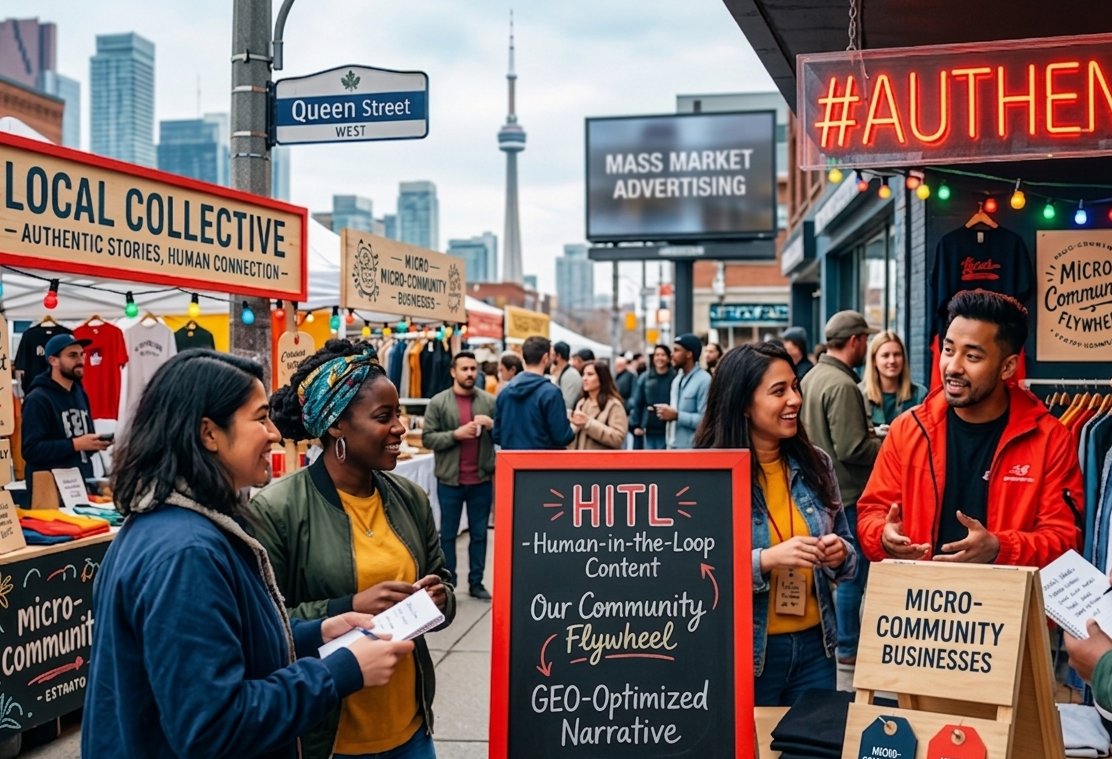
In an era where artificial intelligence can churn out 50 search-optimized blog posts in ten seconds, raw content volume has lost its value. We have officially reached peak algorithmic fatigue. Audiences in 2026 are not suffering from a lack of information; they are suffering from a deficit of genuine human connection.
Following up on our breakdowns of Taylor Swift’s masterclass in fandom narrative and the viral phenomenon of Labubu’s micro-fandom drops, now is a critical turning point for culture and commerce. For small- to medium-sized businesses trying to cut through digital noise, the playbook has changed. Mass marketing through cold, automated churn is dead. Building hyper-focused micro-communities around an authentic, human-led narrative is now the only bulletproof strategy for long-term survival.
The 2026 Content Trust Gap: Why Human-in-the-Loop is Non-Negotiable
The move away from hands-off marketing automation stems from a clear reality: consumers can spot unedited machine-written content immediately, and they are actively rejecting it.
As highlighted in our analysis, Navigating the Human-AI Workplace Blueprint for 2026, relying solely on autonomous AI systems without human oversight yields subpar strategic results. Pure automation creates an operational void where nuance, cultural context, and genuine empathy are lost. To achieve real business impact, a Human-in-the-Loop (HITL) architecture must be present. AI functions best as an accelerator for data processing and drafting, but human refinement is what establishes trust, brand voice, and emotional resonance.
This “AI trust penalty” is backed by rigorous global data. According to Canva’s 2026 State of Marketing and AI Report, while 97% of marketing leaders use AI tools daily, 78% of consumers still prefer human-made adverts, with 87% stating that effective advertising requires a distinct human touch. Further research published by NP Digital confirms that only 16% of consumers strongly trust pure AI-generated content, with engagement dropping drastically when audiences suspect a brand is speaking to them through an unedited machine.
Search engines have evolved to penalize this synthetic volume. Modern search architecture, specifically Google’s Generative Experience and AI Overviews, presents a high bar for content creators. Generative Engine Optimization (GEO) no longer rewards simple keyword density or mass publishing. Instead, search algorithms synthesize entity relationships, brand sentiment, and real-world trust signals. If your brand lacks authentic human input and community validation, AI search engines will bypass your content in favour of sources with verified human expertise.
The Mechanics of Micro-Communities: Learning from Cultural Giants
Why did Taylor Swift’s Eras Tour break global revenue records, and why do adult consumers queue outside specialty boutiques for hours to buy a single Labubu vinyl figurine? Neither phenomenon relied on generic digital display ads or mass email blasts. Both built self-sustaining micro-communities anchored by deep lore, shared identity, and intentional scarcity.
Micro-communities are focused, highly engaged groups of consumers bound together by a shared passion, geographic identity, or set of values. Instead of broadcasting a message to one million passive followers, community-led brands nurture 1,000 active advocates who participate directly in the brand’s ecosystem.
Data from Marketing LTB shows that community-led initiatives reduce customer acquisition costs (CAC) by an average of 32% while driving a 46% higher customer lifetime value (CLV). Furthermore, brands with active micro-communities grow revenue 2.1 times the rate of those relying solely on traditional acquisition funnels.
When members feel like insiders, they transform from casual buyers into brand ambassadors who generate organic word-of-mouth growth across localized networks.
Local Case Study: How Canadian Retailers Win on Home Turf
This shift is particularly evident in the Canadian retail landscape, where consumers increasingly favour localized authenticity over multinational corporate messaging.
Consider an independent apparel retailer in Toronto’s Queen Street West district. Rather than spending thousands of dollars on generic social media ad placements to compete with fast-fashion giants, the retailer launched a private Discord server and hosted exclusive monthly in-person trading sessions for local streetwear collectors. By pairing limited-run, locally designed apparel with hyper-localized community events and human-curated discussions, the brand achieved an 80% repeat-purchase rate within six months.
This aligns directly with national consumer trends. A study conducted by The UPS Store Canada revealed that 84% of Canadians pay close attention to product origins, and 77% are willing to pay a premium for locally sourced Canadian products. When small businesses combine local sourcing with dedicated community spaces, whether digital or physical, they build a defensive moat that automated, offshore competitors cannot replicate.
Executing a Bulletproof Narrative Strategy: A Technical Blueprint
To translate community-led growth principles into execution, small brands must move away from generic copywriting and adopt structured, human-guided narrative frameworks. Here is how to execute a high-trust, GEO-optimized brand narrative in 2026.
Step 1: Define Your Core Lore (The Entity Signal)
- Every strong narrative requires a clear origin, a distinct voice, and explicit values. In SEO terms, establishing your “entity” means ensuring search engines recognize who you are, what you stand for, and who your community serves. Avoid bland corporate jargon; use specific, human speech patterns that reflect your brand’s true personality.
Step 2: Operationalize Human-in-the-Loop Content Workflows
- Establish a two-tier content architecture where AI models generate raw structural drafts, but human subject matter experts refine every output for tone, factual accuracy, and original insight before publication.
Step 3: Implement the Community Flywheel
- Transition your marketing funnel into a continuous feedback loop:
- Creation: Publish original, human-driven content that highlights real customer experiences.
- Participation: Invite audience interaction via private groups, local events, or exclusive polls.
- Advocacy: Reward highly engaged members with early access, badges, or co-creation opportunities.
- Expansion: Allow advocates to invite peers; this drives low-cost organic growth.
Step 4: Optimize for GEO and E-E-A-T
- Generative Engine Optimization relies heavily on Experience, Expertise, Authoritativeness, and Trustworthiness (E-E-A-T). Embed real customer reviews, verified case studies, and transparent behind-the-scenes content into your site structure. Google Overviews prioritize brands that demonstrate real-world community validation over synthetic, mass-produced text.
Building Sustainable Growth
Today’s success does not belong to brands with the largest automated generation budgets. It belongs to the brands that listen closest to their audience, keep humans at the centre of their narrative strategy, and cultivate genuine spaces for community connection. By choosing micro-communities and Human-in-the-Loop authenticity over mass automated marketing, small businesses can lower acquisition costs, elevate customer loyalty, and secure top placement across AI-driven search landscapes. Focus on your narrative, empower your core supporters, and let authentic human engagement drive your long-term growth.