
|
Getting your Trinity Audio player ready... |
Beyond the Keyword
Mastering GEO for Local Foot Traffic
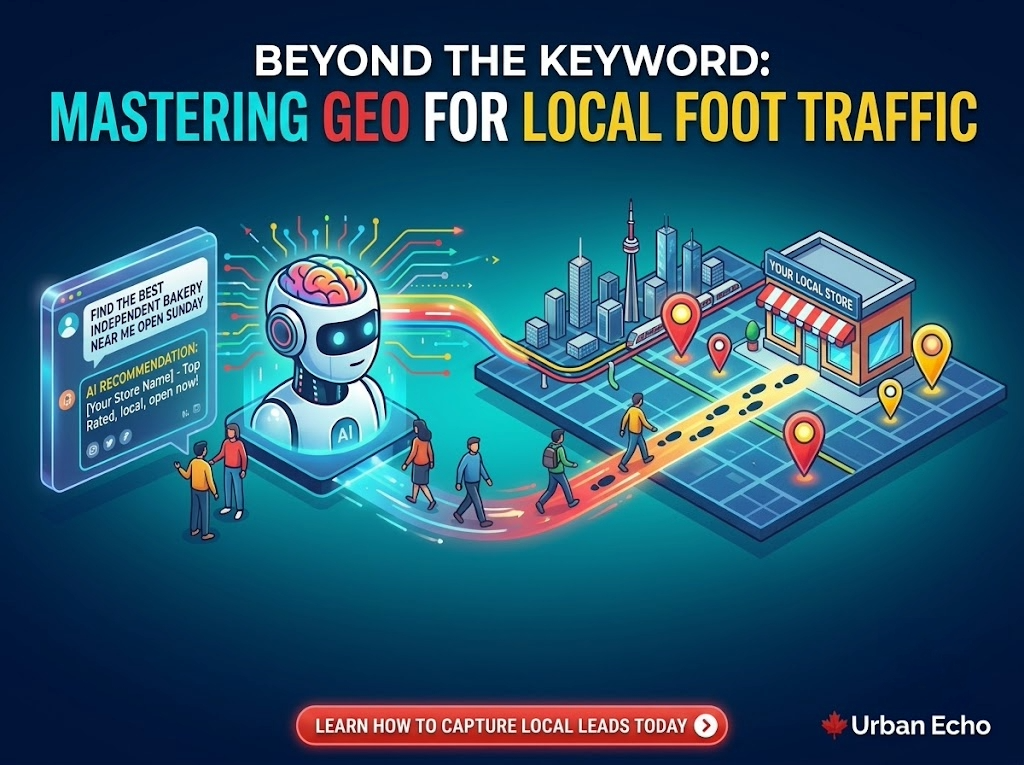
For over a decade, the standard playbook for getting local customers through the doors of brick-and-mortar storefronts was predictable: identify a high-volume keyphrase, sprinkle it across landing pages, earn backlinks, and hope Google’s ranking algorithm smiled on your domain.
Today, consumers no longer scroll through pages of blue links when deciding where to shop, eat, or hire a professional. Instead, they pose complex, context-rich questions directly to AI assistants like Google Gemini, ChatGPT, SearchGPT, and Perplexity. When someone asks an AI assistant for a local recommendation, they aren’t seeking research links; they want a definitive, contextually precise answer.
This structural shift from keyword matching to conversational synthesis created a new digital imperative: Generative Engine Optimization (GEO). As detailed in our comprehensive comparison of Google SEO and AI Overview, generative engines evaluate search queries fundamentally differently than legacy web crawlers. For Canadian storefronts, regional service providers, and brick-and-mortar brands, mastering GEO is no longer an experimental growth hack; it is the core survival mechanism for capturing foot traffic.
The Zero-Click Reality: Hard Statistics Behind the Shift
Many small and medium enterprises (SMBs) account for over 98% of employer businesses across Canada, according to Statistics Canada and continue to channel marketing budgets into 2020-era keyword stuffing. They remain unaware that modern AI interfaces actively synthesize web content to resolve queries without sending users to external sites.
The data underscores a fundamental transformation in consumer search behaviour:
- The Zero-Click Spike: Research published by Search Engine Land demonstrates that zero-click searches have risen above 68% following the default integration of Google AI Overviews across mobile and desktop interfaces.
- CTR Compression: When an AI Overview appears at the top of a search results page, the average click-through rate (CTR) for the top-ranked organic link plummets from 7.3% down to a meagre 2.6%.
- AI Feature Prominence: Industry benchmark reports from Gartner reveal that generative summaries now trigger more than 55% of all commercial and local service searches.
- Higher Conversion Quality: Studies from digital agency Seer Interactive show that while total site traffic from AI models may be lower in volume, visitors referred by AI summaries convert at rates up to 15.9%—nearly 9x higher than traditional organic search traffic (1.76%).
- Generative Engine Optimization Lift: Breakthrough academic research from Princeton University, Georgia Tech, and IIT Delhi (KDD 2024) proved that implementing GEO techniques—such as adding verified statistics and authoritative citations—boosts a brand’s visibility in generative search engine outputs by up to 41%.
Demystifying Technical GEO Concepts
Transitioning to Generative Engine Optimization (GEO) requires looking past standard meta tags to understand how Large Language Models (LLMs) parse human knowledge. To optimize effectively, local business owners must grasp three underlying technical mechanisms:
1. Vector Search and Semantic Intent
Legacy search engines relied on linguistic matching, looking for exact text strings like “bakery Toronto.” Generative engines convert words into high-dimensional numerical vectors, allowing them to evaluate semantic relationships such as mood and implied intent.
- Practical Example: If a customer asks an AI, “Where can I find a quiet, sunlit cafe in Toronto’s Annex neighbourhood with fast Wi-Fi and artisan vegan pastries?” the LLM does not look for a page containing that exact sentence. Instead, it maps vector concepts like “quiet workspace,” “fast Wi-Fi,” and “vegan pastries” against business entities near that location that consistently possess those attributes in customer reviews, web copy, and local press mentions.
2. Entity Resolution & NAP Consistency
Entity resolution is the mathematical process by which an AI engine determines that disparate online mentions refer to one specific physical location. If a business’s Name, Address, and Phone number (NAP) vary across directories, the AI model registers low statistical confidence and excludes the store from recommendations.
- Practical Example: If your shop is listed as “Kitsilano Artisan Goods Inc.” on Google, but “Kitsilano Goods” on Yelp with a slightly different phone number, the AI can’t be sure both listings are the same business. Rather than risking a mistake, it simply recommends a competitor whose information matches perfectly across the web.
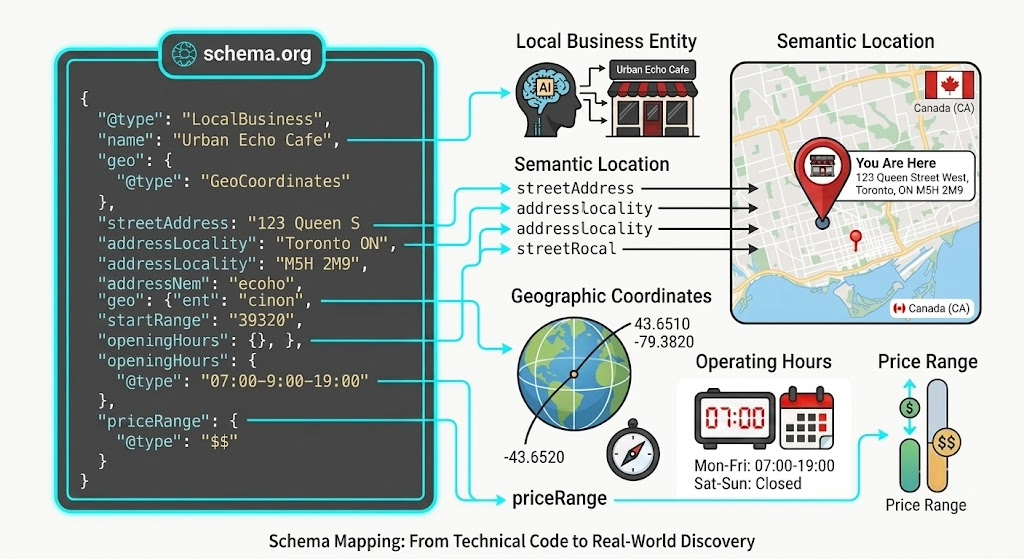
3. Structured JSON-LD Schema Markup
Schema markup is standardized code embedded into your website’s backend. According to Google Search Central documentation, adding this structured data eliminates ambiguity for AI crawlers by explicitly defining your business attributes.
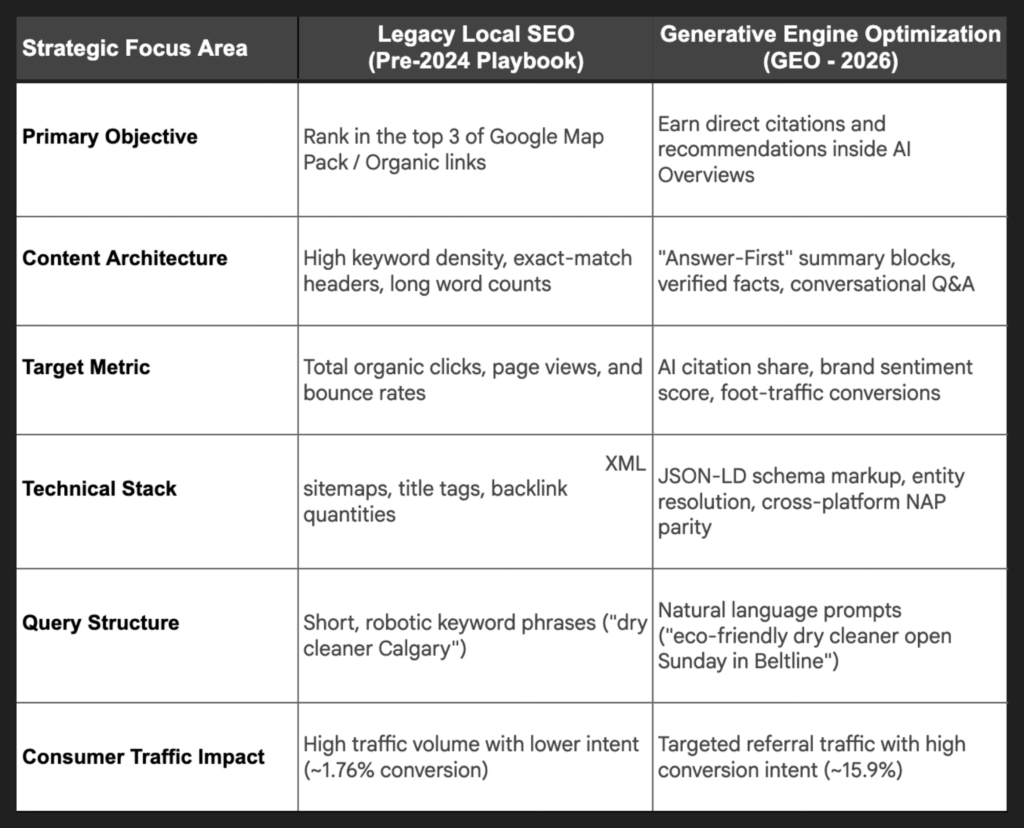
Comparative Matrix: Legacy SEO vs. Generative Engine Optimization (GEO)
Pivoting your local marketing strategy requires shifting focus across operational dimensions:
Actionable GEO Playbook for Canadian Local Businesses
Executing a successful GEO strategy demands a systematic roadmap designed for the modern AI ecosystem:
Step 1: Conduct a Multi-LLM Machine Visibility Audit
Begin by evaluating how AI platforms currently view your brand. Test natural conversational prompts across Google Gemini, ChatGPT, Perplexity, and Apple Intelligence.
- Action Item: Query prompts such as: “What is the most recommended eco-friendly home cleaning service in Calgary inner city?” Document whether your business appears, how your services are described, and which competitors are cited instead.
Step 2: Implement “Answer-First” Content Architectures
AI models prioritize immediacy. Data indicates that over 44% of cited web snippets are extracted from the top 30% of a web page.
- Action Item: Reorganize landing pages around conversational headers (H2/H3 tags) that mirror real customer inquiries. Place a definitive 2-3 sentence answer directly beneath each header, followed by detailed service specifications, pricing, and local context.
Step 3: Standardize the Canadian Directory Ecosystem
Conflicting business details generate algorithmic uncertainty. When AI crawlers encounter inconsistent operating hours or addresses, they routinely suppress the business to prevent negative user experiences.
- Action Item: Harmonize your official business name, postal address, local phone number, and holiday hours across Google Business Profile, Apple Maps, Bing Places, Yelp Canada, YellowPages.ca, and regional chambers of commerce.
Step 4: Capitalize on Canadian Consumer Identity
Consumer studies by The UPS Store Canada reveal that 84% of Canadians pay close attention to product origin, and 77% actively prefer supporting Canadian small businesses.
- Action Item: Weave explicit localized context into your site’s copy. Mentioning specific neighbourhoods (e.g., “Serving Old Montreal and Griffintown”), regional ingredient sourcing, and local community partnerships provides the rich semantic data LLMs seek when users ask for local solutions.
Step 5: Cultivate Detailed, Context-Rich Customer Reviews
AI engines do not merely calculate averages of star ratings. They also perform sentiment analysis on the text within reviews to extract specific entity attributes.
- Action Item: Encourage satisfied customers to leave descriptive reviews on Google and Yelp. Prompts like “Mention what service you received and which location you visited” generate valuable semantic review signals that AI models cite during hyper-specific local queries.
Why Authentic Human Experience Dominates AI Retrieval
There is a striking paradox in 2026 digital marketing: as artificial intelligence takes over search retrieval, authentic human experience becomes the single most valuable content attribute. Generative search models are heavily fine-tuned to identify and demote repetitive, low-effort AI-generated blog posts.
Under Google’s E-E-A-T (Experience, Expertise, Authoritativeness, and Trustworthiness) guidelines, AI models prioritize content that demonstrates real-world proof of operation. A local shop or service provider that shares genuine case studies, highlights neighbourhood involvement, and publishes verified facts provides the exact semantic depth LLMs require.
By structuring your web presence with robust schema data, ensuring directory accuracy across all platforms, and addressing customer questions with clarity, you ensure that when AI models guide local consumers on where to spend their money, your physical doors are the ones they enter.
Capturing foot traffic isn’t about tricking a crawler; it’s about becoming the definitive, verified, and contextually rich answer when a local customer asks an AI engine where to spend their money; it’s about becoming the definitive, verified, and contextually rich answer when a local customer asks an AI engine where to spend their money.
While zero-click searches and compressed click-through rates may feel daunting, Generative Engine Optimization shifts the operational focus from vanity web traffic to high-intent conversions. By aligning your digital footprint with clean JSON-LD schema, immaculate cross-platform NAP consistency, and genuine, community-rooted human experiences, you transform generative search engines from competitors into your most active brand ambassadors. The local storefronts that embrace this structural transition today won’t just survive the generative shift, they will own the physical streets of tomorrow.