
|
Getting your Trinity Audio player ready... |
The “Unhired” AI Agent
Why Small Businesses Struggle to Deploy Autonomous Workflows
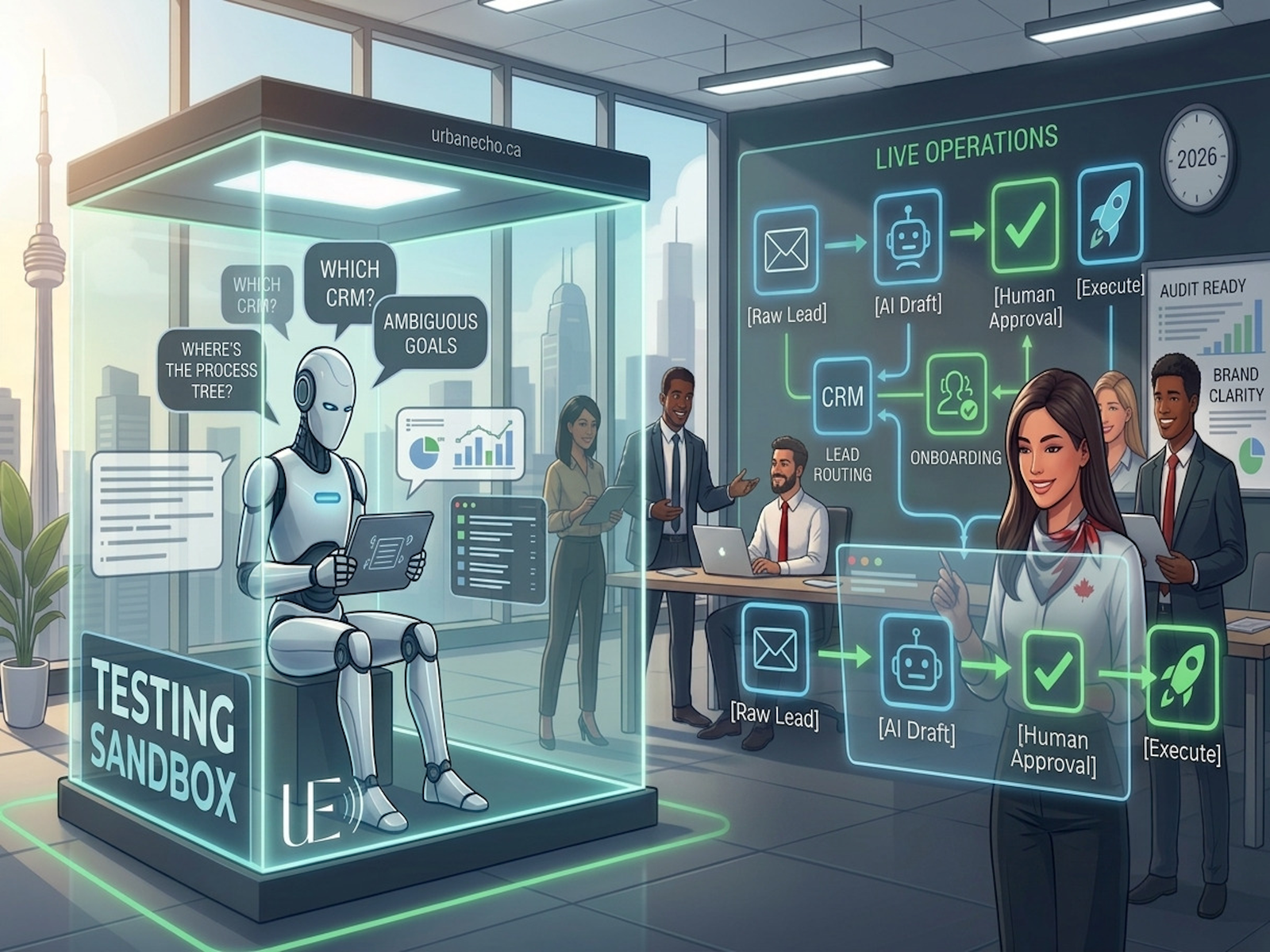
In our previous articles, Navigating the Human-AI Workplace of 2026 and The 2026 Recipe for Agentic Success, we explored how autonomous AI agents and intelligent workflows are reshaping modern digital strategy. On paper, the promise of 2026 tech is irresistible: self-governing software agents taking over customer onboarding, managing content pipelines, routing leads, and handling repetitive administrative overhead.
Yet as we move through the first quarter of the year, a stark reality check has set in across the Canadian small business ecosystem.
While enterprise tech headlines celebrate the era of autonomous business, thousands of small- to medium-sized businesses (SMBs), local storefronts, and non-profits find themselves stuck. They have invested in shiny new AI subscriptions, tested dozens of prompts, and launched pilot projects, only to watch their “digital workers” sit idle in what developers call the sandbox phase.
The issue isn’t that AI models aren’t smart enough. The problem is that most businesses are trying to automate messy, unstructured processes before establishing the core strategy, clear copywriting, and governance frameworks required for AI to succeed.
The “Proof-of-Concept” Trap: What the 2026 Data Shows
If your business feels stalled in turning AI promises into real-world ROI, you are far from alone. Industry metrics show a widening gap between AI ambition and operational reality:
- The Deployment Gap: The 2026 Gartner Hype Cycle for Agentic AI reveals that while over 60% of organizations plan to deploy AI agents within the next two years, only 17% have successfully deployed operational agents to date.
- The Pilot Graveyard: Research by IDC and Lenovo indicates that an astounding 88% of AI proofs-of-concept (POCs) never make it to mass production. Businesses build working prototypes in test environments but fail to integrate them into live operational workflows.
- Workflows Left Untouched: According to benchmark research published in The Agile Brand Guide, although 90% of organizations actively use AI tools, only 21% have actually redesigned their underlying operational workflows to support true automation.
Plugging an advanced AI model into a broken or ambiguous workflow doesn’t create efficiency; it simply accelerates confusion at scale.
Decoding the Tech Jargon: Concepts Every SMB Owner Should Know
To understand why AI agents get “unhired” before they do meaningful work, it helps to break down key concepts into plain business English:
1. Agentic Workflows vs. Basic AI Chatbots
- Basic AI (Chatbot): You ask ChatGPT or Claude to write an email response, and it generates text. You still have to copy, paste, review, and click “send.”
- Agentic Workflow: An autonomous software chain given a specific goal (e.g., “Qualify incoming contact form leads and schedule discovery calls”). The agent reads the form submission, checks your CRM, cross-references calendar availability, drafts a customized response, and updates your sales records—all without manual copy-pasting.
2. The “Sandbox” Trap
A sandbox is an isolated testing environment where developers experiment with code or AI prompts without affecting real-world data or customer interactions. Small businesses get trapped in the sandbox when they spend months playing with AI prompts in isolation without ever linking the tool to live databases, payment systems, or customer-facing channels.
3. Deterministic vs. Probabilistic Tasks
- Deterministic Tasks: Processes with zero ambiguity where $1 + 1$ always equals $2$. Example: Moving a customer’s email address from a form submission into an Excel spreadsheet. Rules-based automation (like Zapier) handles this flawlessly.
- Probabilistic Tasks: Processes involving human nuance, tone, and judgment. Example: Responding to an unhappy client’s email. AI models operate probabilistically—they guess the best outcome based on pattern recognition. Without guardrails, probabilistic systems risk making public or financial missteps.
The Missing Pillar: Human-in-the-Loop (HITL) Architecture
The single biggest reason small businesses abandon autonomous workflows is the fear of loss of control. When an unguided AI agent produces a hallucinated quote or sends a tone-deaf response to a donor, management automatically rejects it. Why? Because AI’s faster output will never outweigh the catastrophic cost of losing a key client or destroying brand credibility.
The solution isn’t abandoning automation; it is adopting a Human-in-the-Loop (HITL) Architecture.
In a HITL setup, the AI agent performs 90% of the heavy lifting—researching context, parsing data, and drafting outputs- but pauses at designated safety checkpoints for a human to review, approve, or adjust before taking high-stakes actions, as seen in the example below.
![A sequential illustration showing how to adopt a Human-in-the-Loop (HITL) Architecture. [Raw Request/Lead] ➔ [AI Agent Gathers Context & Drafts Action] ➔ [HITL Checkpoint: Human Approval] ➔ [Execution]](https://urbanecho.ca/wp-content/uploads/2026/08/Gemini_Generated_Image_a428fra428fra428-1024x559.png "The “Unhired” AI Agent 2")
By keeping human judgment at critical decision points, your team saves tens of hours per week on manual drafting while maintaining complete oversight over brand voice, compliance, and client trust.
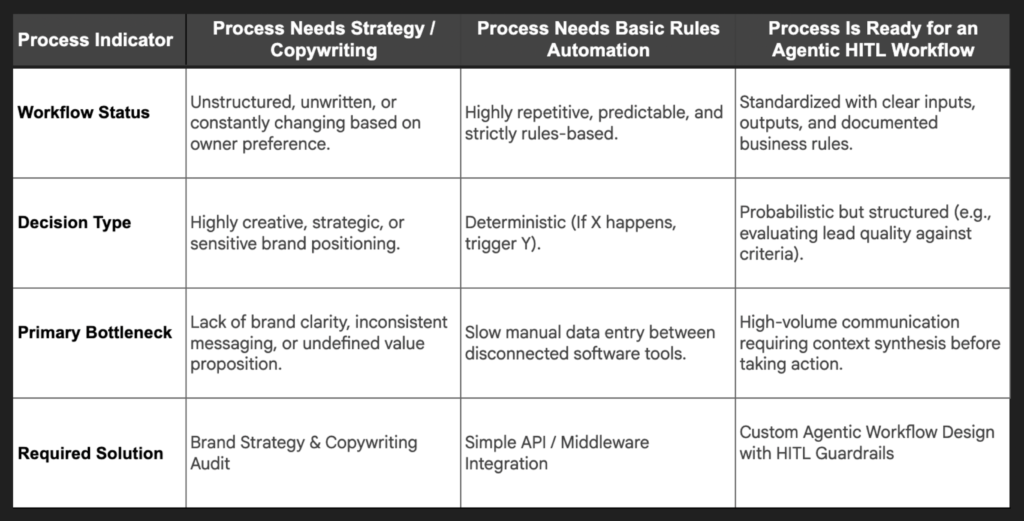
Audit Framework: Is Your Process Ready for an AI Agent?
Before spending thousands on software integrations, use this practical matrix to determine what your business process actually needs:
3 Steps to Get Your AI Agents Out of the Sandbox
If your business is struggling to implement autonomous workflows this quarter, follow this step-by-step roadmap to build momentum:
- Conduct a Process Readiness Audit: Map out your customer journey and operational workflows on paper. If a process cannot be described as a clear, step-by-step decision tree, an AI model will fail to execute it.
- Fix Content and Messaging First: AI agents rely on your existing documentation, website copy, and sales materials to learn how to speak for your business. Clear, authoritative copywriting provides the underlying “knowledge base” your AI needs to function accurately.
- Deploy Guardrails Before Full Autonomy: Start every new automation as a draft-only agent. Require human sign-off for the first 100 executions. Once the agent demonstrates consistent accuracy, remove the checkpoint for low-risk tasks while retaining HITL oversight for high-value interactions.
The true promise of 2026’s agentic shift isn’t about replacing human judgment with autonomous algorithms—it is about giving your team the operational infrastructure to scale what already works. When you pair clear brand messaging, mapped processes, and Human-in-the-Loop guardrails, AI transforms from an expensive sandbox experiment into a reliable engine for growth. Stop waiting for autonomous tools to fix unstructured workflows. Fix the foundation first, keep your people at the wheel, and your “unhired” digital workforce will finally get to work.