
|
Getting your Trinity Audio player ready... |
Navigating the Human-AI Workplace of 2026
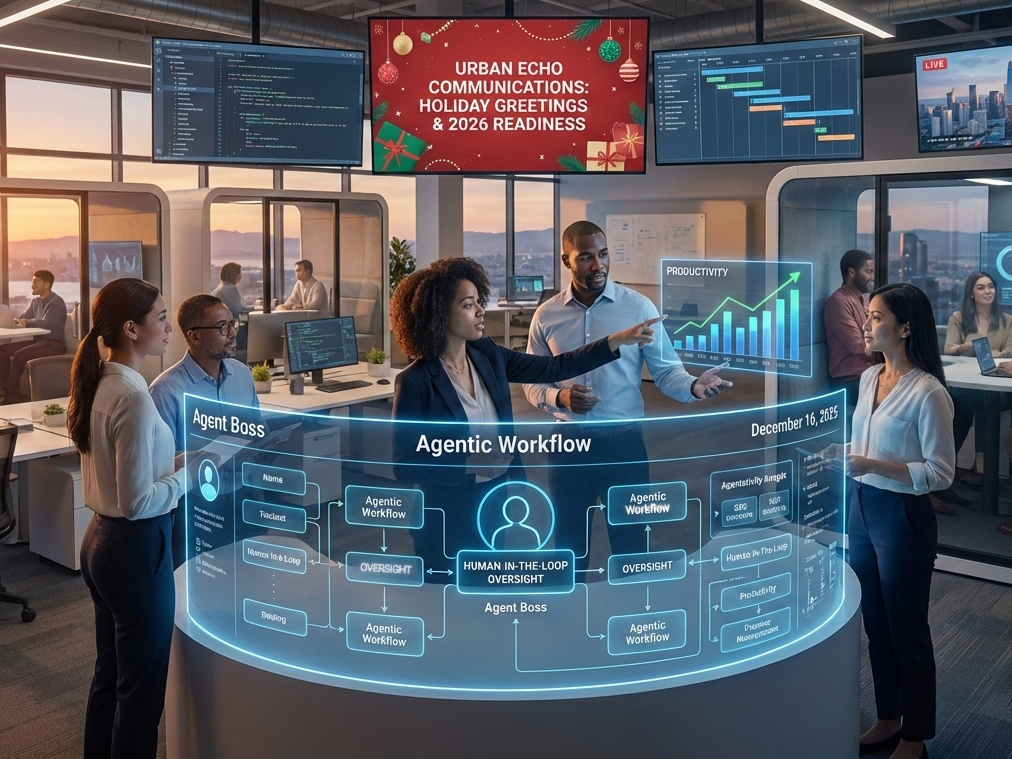
As we close out 2025, the novelty of simply “chatting” with computers has faded into the background, replaced by the high-stakes reality of Agentic Workflows. If 2025 was defined by the “Great Integration,” 2026 will be defined by security, governance, and the preservation of human agency.
Data from the final quarter of 2025 shows that AI is no longer a fringe tool used by early adopters; it has become a fundamental pillar of the modern economy. According to recent labour statistics, daily usage has climbed to 12% of the U.S. workforce, with nearly half of all employees now using AI in some capacity to manage their daily workflows. This shift represents a profound change in how we conceptualize work, moving from manual task execution to high-level system orchestration.
1. Implementing “Human-in-the-Loop” (HITL) Architecture
In 2026, safety is no longer just about firewalls and encryption; it is about oversight and ethical alignment. The most successful Canadian firms are moving away from “black-box” systems—where an AI makes decisions without explanation—and toward Human-in-the-Loop (HITL) architectures.
In an HITL framework, the AI acts as a sophisticated co-pilot that proposes solutions, but a human retains the final “Go/No-Go” authority. This ensures that while AI handles the heavy lifting of data synthesis, the final ethical and strategic decisions remain a human prerogative. For organizations, this isn’t just a safety measure; it’s a way to foster trust and confidence. Stakeholders are more likely to embrace the technology when they understand how the decision was reached. Clear governance frameworks that prioritize transparency help mitigate the risks of algorithmic bias and ensure that the “human touch” remains at the heart of the business.
2. The Economic Case: A Productivity Premium for SMEs
The financial incentive for this integration is clear. Research from the University of St. Andrews suggests that AI adoption can result in productivity premiums of up to 133% for small and medium-sized enterprises (SMEs). This is particularly vital in a competitive global market where efficiency is the primary differentiator.
Closer to home, the CFIB (Canadian Federation of Independent Business) reports that for every $1 invested in digital tools, Canadian businesses see an average return of $1.60 within the first year. For a local marketing team, this doesn’t just mean “working faster.” It means using AI to analyze complex consumer behaviour in real-time, allowing the team to pivot campaigns instantly. By automating the “data crunching,” employees are freed to brainstorm and implement creative ideas that a machine simply cannot replicate.
3. Radical Reskilling and the Rise of the Agent Boss
The job description of 2026 looks vastly different from what it did just two years ago. The 2025 Work Trend Index highlights the rise of the “Agent Boss.” This term describes employees who act as the “CEO” of their own personal startup consisting of specialized AI agents.
This shift requires a new type of leadership. Managers must now become facilitators who encourage experimentation and risk-taking. However, a significant gap remains: while 86% of global employers expect AI to transform their business by 2030, only about one-third of employees feel they have been properly trained to handle these tools. To bridge this divide, Canadian companies must move beyond one-off seminars and invest in:
- Mentorship Schemes: Pairing “AI-native” younger employees with experienced leaders to share technical skills and strategic wisdom.
- Comprehensive Training: Investing in workshops that focus on “prompt engineering” and the ethical implications of AI.
- A Culture of Innovation: Creating safe spaces where teams can explore AI applications without the fear of failure or job displacement.
Conclusion: The Synergy of the Human-AI Partnership
The evolution of AI in the workplace has moved past the initial excitement and into a critical phase of oversight and empowerment. Success in 2026 will depend on organizations embracing the partnership between human creativity and machine efficiency.
As we enter this new era, businesses that proactively align technology with human agency will safeguard their operations, unlocking a new level of productivity and innovation. The Human-AI workplace isn’t a future possibility—it is our current reality. Those who master the art of “Human-in-the-Loop” will lead the way.

As we navigate the final weeks of 2025, the team at Urban Echo Communications wants to pause and celebrate the incredible resilience of our partners. This year, we’ve seen technology move faster than ever, but it’s the human voices—the storytellers, the strategists, and the visionaries—that give that technology its purpose. The Human-AI Workplace is not simply about technology; it’s about harnessing human potential and creativity in tandem with AI advancements.
Whether you are automating your outreach or perfecting your brand’s digital twin, remember that the heart of communication remains a human connection. May your holidays be filled with rest, and may your 2026 be a year of bold, safe, and inspired innovation.
Warmest Wishes,